
Share Edna (Eddie) Dix Crocker's obituary with others.
Invite friends and family to read the obituary and add memories.
Stay updated
We'll notify you when service details or new memories are added.
You're now following this obituary
We'll email you when there are updates.
Select your format and elements to print

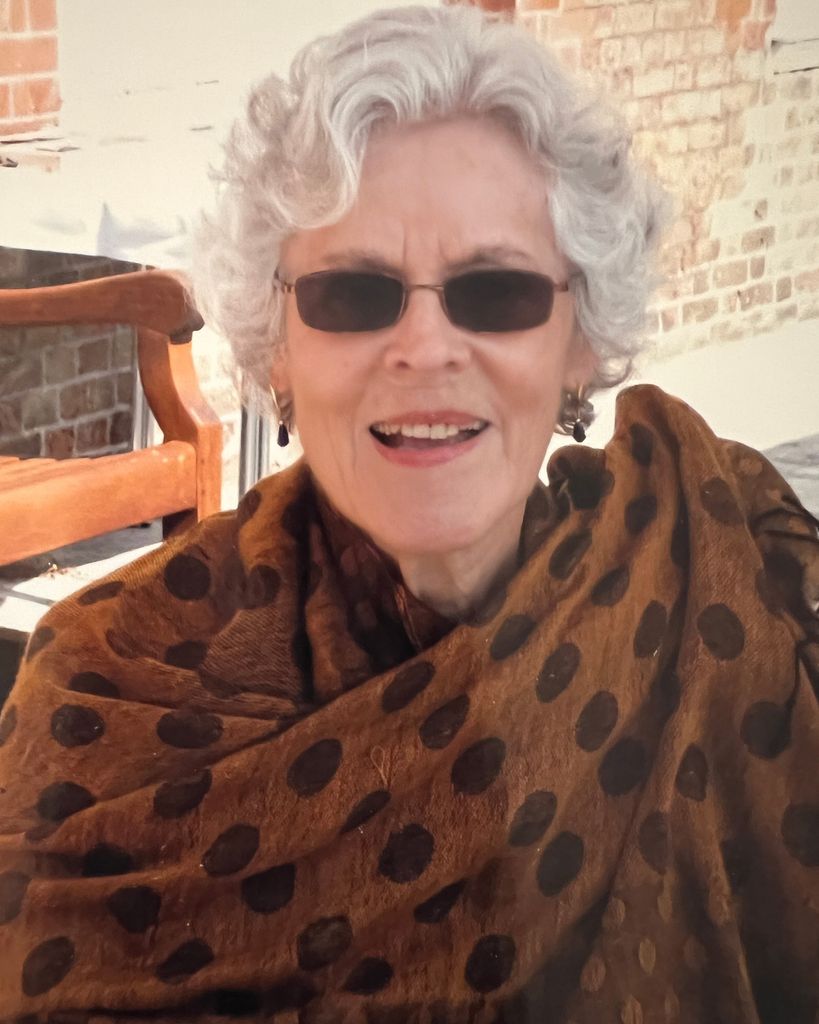
Edna (Eddie) Dix Crocker
Oct 15, 1936 — Dec 9, 2025
Share Edna (Eddie) Dix Crocker's obituary with others.
Invite friends and family to read the obituary and add memories.
Stay updated
We'll notify you when service details or new memories are added.
You're now following this obituary
We'll email you when there are updates.
Select your format and elements to print



Edna (Eddie) Dix Crocker, a teacher who used creative dramatics, her bilingual training, and science to inspire elementary and middle school students in Maryland, Washington, D.C., and Colorado, died on Dec. 9. She was 89.
She passed away peacefully at Kensington Park Senior Living in Kensington, Md. The cause of death was Alzheimer’s Disease. At her bedside was her beloved husband of 67 years, David Crocker, a professor emeritus in the School of Public Policy at University of Maryland. She was known for her radiant spirit, sense of adventure, concern for others, and playful sense of humor, qualities that touched everything she did in her full and varied life.
Eddie knew success as a stage actress and director at DePauw University and in community theater in Fort Collins, Colo. Her theatrical work led to a position as a high school drama teacher and theater director—and to her subsequent career as a teacher of creative dramatics, reading, and English as a Second Language in northern Colorado, Washington, and Prince George’s County. In the classroom, she used improvisation techniques, animated story-telling, puppets and masks that she made herself, and critical thinking. She encouraged her students to explore their individual imaginations and work together. In retirement, she returned to a girlhood interest in science, and founded a mentoring program in science and math for middle school girls. She was always looking to promote equity in education.
Stage highlights included the roles of Emily Webb in Thornton Wilder’s Our Town at DePauw in 1958, where she earned acclaim for Emily’s final soliloquy: “Good-bye to clocks ticking. And Mama’s sunflowers. And food and coffee. And new-ironed dresses and hot baths.” Eddie also played Widow Quin in J.M. Synge’s The Playboy of the Western World at Colorado State University in 1969. A review in the student newspaper praised her Widow Quin as “a shrewd, calculating woman with a beautiful brogue.” In 1970, she directed Aristophanes’s Lysistrata in an outdoor production at CSU that was informed by the anti-war movement. “We were protesting the Vietnam War,” she said years later. “We went out and did guerrilla theater.”
The set design included a paper-mâché puppet with a large phallus, and she was nearly arrested for having it so prominently displayed. The original rock score enhanced the play’s contemporary message. At the time, she wrote to family, “I’ve been thoroughly enjoying my research into the Athenian society during Aristophanic comedy.” Her research included a conversation with the political philosopher Hannah Arendt about Arendt’s scholarship on the political life of the Greek city-state. A CSU reviewer praised “the al fresco production” of the Aristophanes comedy “for prov[ing] that there is life in the old boy yet.”
Her excellent Spanish and work in bilingual education were furthered by two extended stays in San José, Costa Rica, as well as her involvement in the Latino community in Fort Collins, where she was a tireless and compassionate advocate for her Mexican-American students. In 2012, she was recognized by Prince George’s County Public Schools for the mentoring program Girls Excelling in Math and Science (GEMS), which she had started in 2006. GEMS was a partnership with the University of Maryland and the American Association of University Women’s, College Park chapter, of which she was president at the time.
Eddie was born in Wooster, Ohio in 1936, and grew up in a civic-minded family. Her father, Raymond E. Dix, like his father before him, was publisher of The Daily Record in Wooster, one of the daily newspapers owned by Dix Communications, the family publishing company founded in 1898. Her mother, Carolyn Gustafson Dix, was a trustee of The College of Wooster, where she also served as dean of women.
With her curly hair, shining brown eyes, and stubborn streak, Eddie turned heads. As a girl, she was passionate about horses. She had a pony named Jessie that she rode bareback and a horse named King. Until 2023, she was still riding at Maryland Therapeutic Riding. She and her older brother, the late Victor Dix, had sleepovers in the treehouse they built in an apple tree. She called her younger sister “Yellen Ellen Watermelon.” She was a good athlete, playing varsity field hockey and basketball at Wooster High School (Class of 1954)—and competed on the debate team, winning the argument against the electoral college. She was accomplished at the piano, and enjoyed theater and science.
Eddie attended DePauw, where she was a Phi Beta Kappa, receiving a BA with honors in English Literature in 1958 and an MA in Philosophy in 1969. As an undergraduate, she spent two summers in France. In Chambon-sur-Lignon, she dug trenches and did other manual labor to help build a new campus for College Cevenol, a school founded by pastors who led community resistance efforts to shelter Jewish refugees during World War II. At DePauw, she discovered theater. As Ann Deaver in Arthur Miller’s All My Sons, Eddie starred opposite her future husband. They kissed for the first time on stage. She applied to Yale School of Drama, and was accepted. But after her college graduation, she married Dave, the love of her life, and returned with him to DePauw for his senior year.
In 1959, they moved to New Haven, Conn., where Dave was a Ph.D. student in Religious Studies at Yale University. Eddie raised their two young daughters, Cathy and Amanda, while taking classes at the Divinity School, directing Dylan Thomas’s Under Milk Wood, and acting in shows at the Yale Dramat.
The family drove west in 1966 to Fort Collins. Dave taught philosophy at Colorado State University, and Eddie directed community and children’s theater, including the musical The Invisible People by William Lavender, which was called a “smooth, colorful and light-hearted production” in a local review. In 1970, while directing Lysistrata, she helped found and later taught at DeSillio School, a free school modeled after Summerhill School in England. DeSillio was housed in an old school house on the edge of town. In 1971, she received her MA in theater arts at CSU. A son, Davey, was born in 1972.
Eddie and Dave lived in Germany in 1973-74 with their three children, and in Costa Rica in 1986-87 with their son. Travel became even more central in their life together after they left Colorado in 1993 and moved to University Park, Md., where Dave was a professor of international development ethics at UMD and Eddie taught at area public schools. Dave’s academic research and study abroad programs took them to Spain, Peru, Morocco, Chile, Colombia, and back again to Costa Rica. They also visited Honduras, Finland, Italy, France, Germany, England, Norway, Yugoslavia, Japan, and Indonesia, including Bali. Eddie, like Dave, loved adventure. They told their children that the world was a big place, thrilling, complicated, and diverse, and travel was an important way to experience it, to challenge complacency.
Summers were spent at the family cottage on Kahshe Lake in Ontario, Canada, swimming, waterskiing, canoeing, and boating. There were also family dinners at a table extended by folding tables and benches to make room for multiple generations, as well as Sunday evening sing-a-longs. From the porch, Eddie and Dave watched the sunset and listened to the water lapping on the rocks below.
With her sparkle and spirit, Eddie made a meaningful contribution to the lives of so many—as teacher, actor, director, world citizen, and family anchor. She was her beloved Dave’s soulmate, their marriage a partnership of love and family, shared interests and beliefs, and intellectual and travel adventures. He was devotedly by her side, always. In the end, when she was cared for by the loving staff in the Haven at Kensington Park Senior Living, they had lunch together, enjoyed music and sang together, often singing “Side by Side” and “Blue Skies” outside as Dave pushed her wheelchair. If the sun was shining on her face, she would say, “This is the best of all possible worlds,” quoting the philosopher Leibniz.
As mother, Eddie nurtured her children’s creativity, intellectual life, and athletic endeavors. Her integrity, compassion for others, and sense of fun influenced all three of them. With her wonderful sense of language and love of story-telling, she supported Cathy’s work as journalist and fiction writer; she encouraged Amanda, today an architect, to explore her artistic talent with shared projects that left them both covered in paint and glue; she attended Davey’s soccer games, becoming his biggest fan as he worked his way up to state championship play, and helped foster his interest in philosophy and science.
In addition to her husband, David Crocker, and her three children, Catherine Crocker and her husband, Stephen Moser, of Larchmont, N.Y.; Amanda Martocchio and her husband, Don, of New Canaan, Conn.; and David Peter Crocker, of University Park, Md; she is survived by three loving grandchildren, Anna Crocker Moser and her husband, Oliver Southall, of Hurstpierpoint, England; Julia Martocchio, of New Canaan, Conn.; and Luke Martocchio, of New York City. Other survivors are sister Ellen Dungan and her husband, Albert, of New Rochelle, N.Y; and sister-in-law Carolyn Dix, of Sanibel, Fla., wife of her late brother Victor Dix.
In lieu of flowers, donations in Eddie’s memory can be made to the National Museum of Women in the Arts, https://secure.nmwa.org/donate/i/tribute, Maryland Therapeutic Riding, https://horsesthatheal.org/donate/, or to Kensington Park Senior Living, Employee Appreciation Fund—The Haven, 3620 Littledale Rd., Kensington, MD 20895. Burial will be private.
To send flowers or plant a memorial tree in memory, please visit our flower store.
Guestbook
Visits: 466
This site is protected by reCAPTCHA and the
Google Privacy Policy and Terms of Service apply.
Service map data © OpenStreetMap contributors